![[personal profile]](https://www.dreamwidth.org/img/silk/identity/user.png)
Sup! We're almost over with the week. That went by pretty quickly, didn't it? I've certainly enjoyed myself putting these things together. Sorry if I don't always reply, but you can bet I'm reading all the comments. It's nice to have something else to do along with browse FS normally, as well. Just as a reminder, if you want to contact me about featuring any particular species or if there's a picture you just have to share, this post will serve nicely for that. PMing me will work fine too.
Now that we're done with that, today's creature is... the rat. I've seen quite a few people go EEEEK RAT EEEEK GET IT AWAY DIRTY GROSS which while not always being entirely untrue in the specific- especially if the rat in question happens to be making its way out of a garbage bin or something- is a very unfair way to treat the species in general.
Rats are smart survivors that pretty much do whatever they can to get by. Did you know that the term you can use to describe a bunch of rats gathering together 'a mischief of rats'? It's my second favourite way to talk about a group of animals, right next to 'a murder of crows'. Also, male and female adult rats are known as bucks and does respectively, but their young babies are called pups or kittens.
There are also a load of different types of rats around (over 60 different species under the Rattus genus alone), so just for today, I'm only going to focus on a few of these.
Fancy Rat - This term is used to refer to domesticated versions of the Brown Rat. If you know of a rat that's a pet (and not a mat or a hat or a cat in a lap and oh man, the temptation to just Seuss this up-), chances are it's probably one of these. They're quite different from their wild relatives in the same way that a Ragdoll is quite different from an Ocelot, and can be any particular colour. They're also very social and can get along well with other animals.


source


source


source

source
Lab Rats - While not quite the same as domesticated pets, these guys should still be recognised for the survivors that they are. Rats are really intelligent and incredibly useful to us in areas from scientific research from how brains work and how we think to figuring out diseases and cures. Traits common to them, such as ingenuity and adaptability, make them well suited for this. There have even been several different lines of rats that have been bred specifically for lab research alone, leading the common image of lab rats being albino when most rats really aren't. Wistar and Sprague Dawley rats are two of the more common types, but there are plenty of others, such as Hairless rats or rats with specific conditions or having particular genes turned on and off.

source

source

source

source
Other Rats - While most of us are probably familiar with the common brown rat and black rat, there are plenty of other types of rats that do live in the wild or have been bred to be kept as pets and are particularly notable! Let's take a look at some of them.
African Soft-Furred Rat -


source
Dumbo Rat -

source

source

source

source
Black Rat / Ship Rat / Rattus Rattus -

source


source
Hairless Rat

source

source
Manx Rat


source

source
Phew, that was a lot of rats. And I could still go on, but for now, I think that'll do! Which brings us to the next bit-
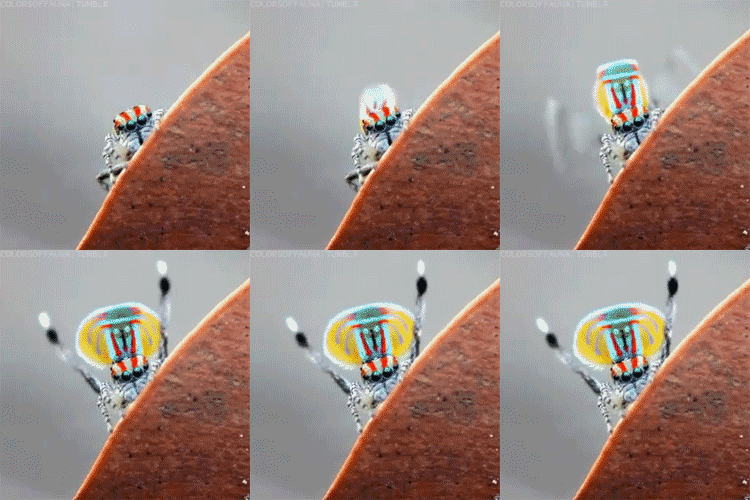
Here's today's spider! And I know most of us should ahve seen gifs and pictures of it before, but it's very pretty and more doesn't hurt. That's right, it's the one and only Peacock Spider. Native to eastern Australia, they're known for their colourful patterns. Here's something, you should keep in mind, though- they're really eeny! As in, really, really eeny, about a fifth-of-an-inch long eeny at their very largest. The males of this species also have flap like extensions on their abdomen that they can fold in or out, similar to a peacock's tail. These are used for display dances when they're trying to mate. People originally did think that these flaps were to help the spider glide from place to place, but that's been debunked.


source


source
That was a long one! Also, want to make any guesses what animal I'll feature tomorrow? I've already decided, but if anyone gets it there might be a surprise in store!
Now that we're done with that, today's creature is... the rat. I've seen quite a few people go EEEEK RAT EEEEK GET IT AWAY DIRTY GROSS which while not always being entirely untrue in the specific- especially if the rat in question happens to be making its way out of a garbage bin or something- is a very unfair way to treat the species in general.
Rats are smart survivors that pretty much do whatever they can to get by. Did you know that the term you can use to describe a bunch of rats gathering together 'a mischief of rats'? It's my second favourite way to talk about a group of animals, right next to 'a murder of crows'. Also, male and female adult rats are known as bucks and does respectively, but their young babies are called pups or kittens.
There are also a load of different types of rats around (over 60 different species under the Rattus genus alone), so just for today, I'm only going to focus on a few of these.
Fancy Rat - This term is used to refer to domesticated versions of the Brown Rat. If you know of a rat that's a pet (and not a mat or a hat or a cat in a lap and oh man, the temptation to just Seuss this up-), chances are it's probably one of these. They're quite different from their wild relatives in the same way that a Ragdoll is quite different from an Ocelot, and can be any particular colour. They're also very social and can get along well with other animals.


source
source
source
source
Lab Rats - While not quite the same as domesticated pets, these guys should still be recognised for the survivors that they are. Rats are really intelligent and incredibly useful to us in areas from scientific research from how brains work and how we think to figuring out diseases and cures. Traits common to them, such as ingenuity and adaptability, make them well suited for this. There have even been several different lines of rats that have been bred specifically for lab research alone, leading the common image of lab rats being albino when most rats really aren't. Wistar and Sprague Dawley rats are two of the more common types, but there are plenty of others, such as Hairless rats or rats with specific conditions or having particular genes turned on and off.
source
source
source
source
Other Rats - While most of us are probably familiar with the common brown rat and black rat, there are plenty of other types of rats that do live in the wild or have been bred to be kept as pets and are particularly notable! Let's take a look at some of them.
African Soft-Furred Rat -
source
Dumbo Rat -
source
source
source
source
Black Rat / Ship Rat / Rattus Rattus -
source
source
Hairless Rat
source
source
Manx Rat
source
source
Phew, that was a lot of rats. And I could still go on, but for now, I think that'll do! Which brings us to the next bit-
Here's today's spider! And I know most of us should ahve seen gifs and pictures of it before, but it's very pretty and more doesn't hurt. That's right, it's the one and only Peacock Spider. Native to eastern Australia, they're known for their colourful patterns. Here's something, you should keep in mind, though- they're really eeny! As in, really, really eeny, about a fifth-of-an-inch long eeny at their very largest. The males of this species also have flap like extensions on their abdomen that they can fold in or out, similar to a peacock's tail. These are used for display dances when they're trying to mate. People originally did think that these flaps were to help the spider glide from place to place, but that's been debunked.
source
source
That was a long one! Also, want to make any guesses what animal I'll feature tomorrow? I've already decided, but if anyone gets it there might be a surprise in store!
+